The huntman steps swiftly and silently through the trees. Over his shoulder he carries a gun, at his belt he has his knife, and that is all he walks with. Picking his path carefully up the mountain, he breaks a small branch every few paces to mark out the way he came.
To the two white boys panting and stumbling along behind, every patch of forest looks the same, every tree is just another tree. But the huntman sees everything. He sees every plant, what you can make out of it, what ailment it can cure. He sees every species of tree and knows which are good for burning or building, how to cut them and what kind of birds you could find in their canopies. He sees every pawprint, he sees what kind of animal was going where and when. And of course his eyes are constantly alert, ready to pick out a snake, lurking in the branches ahead. The snake is the huntman's only enemy in this forest.
The forest floor is damp and gloomy, only the odd ray of light from above making it down to the soft, thick bed of fallen leaves underfoot. During the day it is quieter, in the heat the bird calls and insect noises don't penetrate so far, and many of the jungle creatures are hidden away, waiting for nightfall.
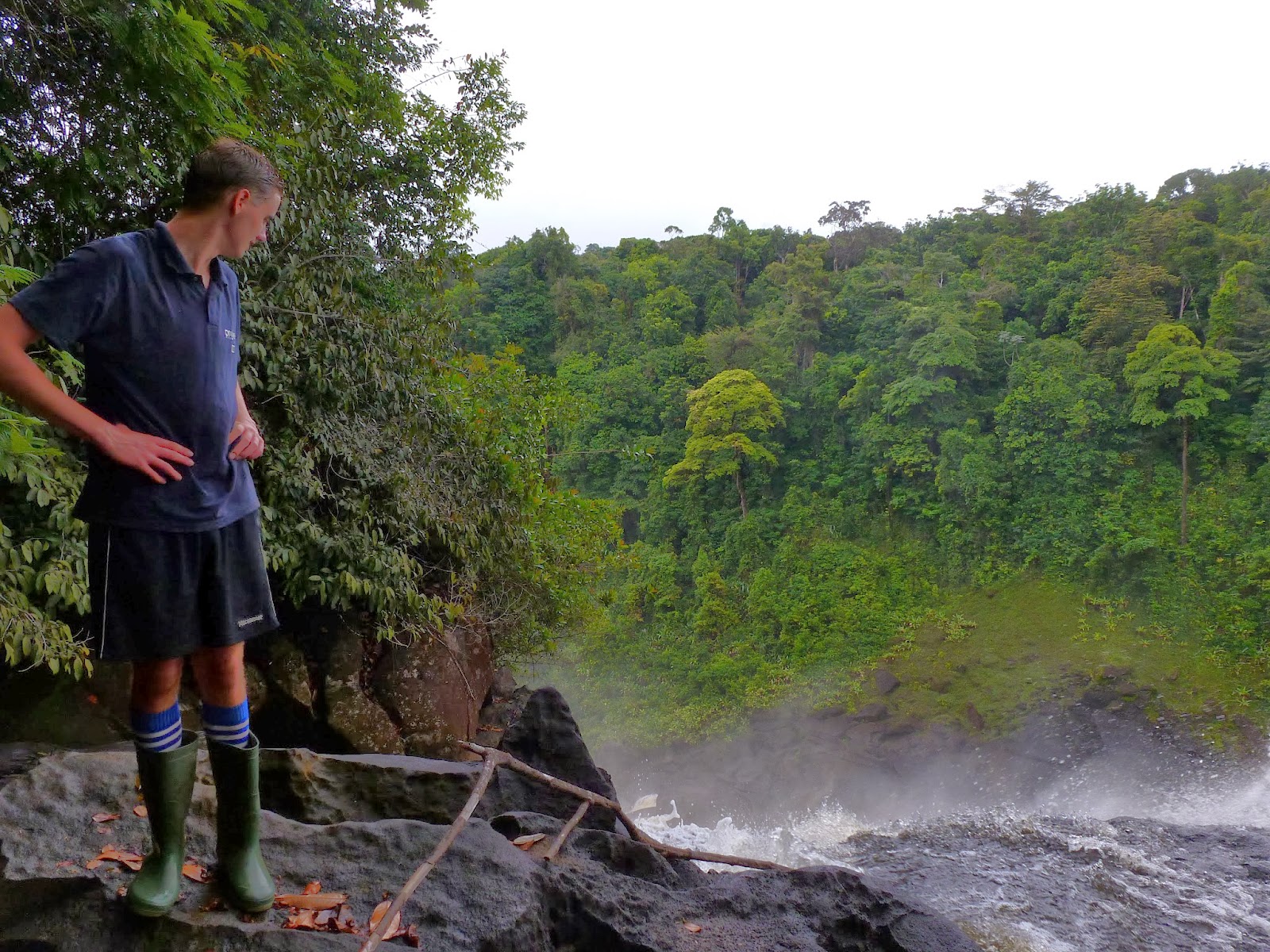
Without map or compass, he navigates by the contours of the slope, the angle of the sun, the faint sound of the river. All of a sudden he stops. "Let's take a look down here". We descend a little past some huge boulders, and the sound of rushing water grows louder. After hacking away some thick vegetation, we climb carefully into the sunlight. We have reached the edge of the river. But it is not only the edge of a river, it is the edge of a waterfall. First time, after hours of walking, our guide has taken us straight to the exact spot where the Potaro river plunges over a huge clifface, turning to white spray before it hits the rocks below, on its way down towards Chenapou village. I am reminded of Fantastic Mr Fox, tunnelling underground and coming up directly underneath Boggis' farmhouse first time.
The most spectacular thing, is the way this wonder of nature is hidden away, deep in a jungle, with not even a trail to it, no spot to land a helicopter, no passage to it by boat. There is no viewing platform, no barrier, not the slightest clearing away of the rainforest. This is a place very few people in the world have been, a place left beautifully undisturbed.
I laugh out loud with joy, applauding, stripping off to take a shower in one of the small stages that come before the main drop. Perhaps the most scenic shower of my life. The dark clouds above begin to open, the air becomes thick with heavy tropical rain. I realise now that I really am surrounded by water in every direction. This is the Land of Many Waters alright.
Later attempting to look up the waterfall on the internet proved to be fruitless. It is marked as Iatuk Falls on my map, but the only information on it that I could find was on a list of waterfalls in Guyana, that vaguely stated that its height is "over 60m". Clearly nothing in comparison to Kaiteur, but pretty big all the same.
How to Make Buns... in the UK
1. Pop down to Tesco in the car to pick up your ingredients.
2. Turn a knob to preheat the oven.
3. Mix the ingredients with the electric whisk and put the dough in the oven.
4. When the timer beeps, take out the finished buns.
5. Stick the dishes in the dishwasher and sit down to enjoy your buns in front of the telly.
How to Make Buns... in Chenapou
1. The week leading up to the baking day must be spent walking around the village, asking around until you find somebody who has a couple of dry coconuts that have fallen from their tree. Don't forget to save up enough money to buy flour and margarine. If you are very lucky the shop might have eggs too, but otherwise you will need to do more asking around to find someone with a hen who is laying eggs.
2. The night before, take your cutlass and hack your way through the tough outer shells of the coconuts.
3. Early on the morning of the bake, set off into the bush with an axe, cutlass and warishi (hand crafted Amerindian backpack). Find some nice pieces of wood and get chopping until your back aches, the sweat is pouring down your face and your hands are beginning to blister. Pack the wood into the warishi and make the punishing journey home with it on your back, the straps digging into your shoulders and forehead, taking care not to let the long pieces of wood snag on branches or bushes.
4.Crack open the coconut shells with the back of your cutlass and begin grating the insides, using an opened out milk tin with holes punched in it.
5. Combine the ingredients by hand, stirring vigorously until your hands are starting to get cramp. Grease the pan and put out the buns to rise.
6. Meanwhile, gather some kindling and small twigs to start the fire. When the fire grows big enough, get somebody to help you arrange some heavy rocks and balance a large empty oil drum on top of them above the fire. Now place a metal sheet on top of the drum and move some burning sticks there to heat the oven from above. From now on these two fires will need constant attention to ensure they have enough fuel and are spread out so as to heat the oven evenly. Use a hand crafted wicker mat to fan the fire when it is getting low.
7. It will now be early afternoon, and the heat of the tropical sun combined with that of the fire is stifling. The smoke drifts into your eyes making them sting, no matter which side of the fire you stand. Nevertheless, crouch down to slide your tray of buns into the oven, then, using an old cloth as an oven glove, replace the lid, securing it with a stick dug into the floor. Stop the hot air from escaping by sealing any gaps with old clothing- be sure to soak them first though.
8. Every now and again, brave the heat and the smoke to open the oven and see how your buns are looking. When you think they are done, use a wooden canoe paddle to slide out the baking tray. Take your buns inside quickly- if you leave them unattended the dogs or chickens or some other creature will be sure to help themselves. (Yes, speaking from experience).
9. Walk down to the river to fetch some water, with which to do the washing up. Scrub hard with a wire brush to get the burnt bits off.
10. It is starting to get late now, so pack up your buns and make sure you give one to everybody who helped you along the way.
11. At last, as the stars come out, sit down in your hammock with a cup of lemongrass tea and enjoy your bun.
I hadn't traveled this fast in almost two months. Whizzing down the familiar stretch of river that we have swum many times, I relished the cool breeze and waved at people on the shore washing their clothes, from my perch on the side of Mervin's leaky boat, propelled by a whining 15 horsepower engine. The sun was starting to lower in the sky, leaving us in the shadows of the towering trees that line the steep, muddy banks. As we swerved around the skeletons of old branches, fallen into the river, sweet little birds would skim across in front of us. They would glide effortlessly and catch the same little insects that the fish were jumping for from below, sending little ripples across the glassy surface of the water.
Past Creek Mouth we went, watching the mountain above the village disappear around the corner, along the straight stretch to Karisparau Landing- the limit of our knowledge of Chenapou. From there on we were in unknown territory. For every previous set of Project Trust volunteers, I thought, this would have been their passageway into Chenapou- coming the opposite direction from Kaiteur- but for us this was a journey into uncharted waters.
The river always brings surprises; after long stretches of seemingly undisturbed wilderness, you will come across a little landing or a dugout canoe hidden away in the shallows, a narrow pathway cut up the bank, even a clearing and a glimpse of a house. Chenapou gets bigger and bigger the harder you look. The real surprises for us this time, though, were the mining camps (tarpaulins stretched out among the trees, surrounded by curious looking machinery and big empty oil drums) and the miners themselves, out working the river on the bizarre looking water dredges.
We came around a bend about ten minutes after Karisparau Landing, to discover a small fleet of these dredges, like a flotilla of drifting little houses in the middle of the river. They were churning out water behind them as if they were being propelled by little paddle steamers. Off the side of the wooden platforms, kept afloat on top of old oil drums, sat topless men, surrounded by tools, engines, buckets, containers of fuel, hammocks, ropes and pieces of wood.
As we drew closer, the steady hum of the boat's outboard was gradually drowned out by the jerking rhythm of old, rickety engines. Metal on metal, metal on wood, coughing and spluttering, shuddering and shaking, the dredges were churning out music like that of the orc mines in a Lord of the Rings movie. On top this the gush of water, being sucked from the depths of the river, through a pipe and over a series of sloping mats, filled what little room was left in the ears. The din was painful to me as we climbed aboard the dredge, but I know the workers, who sit there all day long with no ear protection, could no longer have enough hearing for it to bother them.
Eventually, the platform ceased to vibrate with the force of a small earthquake and a blissful silence filled the air as the engines wound down to a halt. I noticed a man who had not been there before. I also noticed it was raining. The sound of the rain on the tarpaulin, usually deafening in itself, had been completely overpowered. The extracted himself from half of his neoprene suit, took off his diving goggles. His job for the fast few hours had been 20 feet down in the murky depths, clearing away the sand to get at the precious gravel beneath, with the hungry, sucking end of the pipe. A tough, dangerous job. His only link to the world above- a little hose blowing air for him to breathe. The sand above him could have closed in and burieds him at any time.
Watch this video on repeat to discover what it is like on a water dredge (put the sound up as high as possible for a more realistic experience).
The belt connecting the motor to the air pump was not running smoothly. Out came the hammer, to take out the nails holding down the pump, they inched it into place, but a hook was in the way. Out came the cutlass to hack off a piece of wood. They started nailing back the pump, but it was at an angle. Out came the cutlass again to quickly fashion a wedge. Then a piece of rope was tied to help secure it from shaking, with a branch cleverly being used to twist the rope and make it taut. I admired the instinctive way the workers improvised with the materials they had, creating a makeshift factory out of pieces of tree and nails.
The rain came down heavily and started making puddles along the edge of the tarpaulin. Emptying the puddles splashed water all over the deck, but it was mostly wet already from the splashing of water from the dredge.
Darkness was beginning to close in, but on the dredges worked as we sped back up towards the village. They continued to chug away hopefully, in their endless search for the precious treasure buried away in the murky depths of the Potaro.
The School Bell sits on the grade 6 teacher's desk, with the stage behind it.
An overview of the main school building, taken from the stage. This is its standard layout, with Ben's grade 5 classroom on the near right, and the grade 6 classroom to the left of that. At the back of the room grades 3 and 4 are taught.
Inside the nursery building now, looking at my blackboard, which, having no legs of its own, leans precariously against a wooden post. Once a grade one child pushed it from the other side and it came over, thankfully not injuring any small children on this side.
The teacher's are supplied with a few large sheets of paper to make teaching resources and posters with. Here is one I drew to help us in maths.
Even for those children who can't read any of the rules, a physical reminder is better than nothing. Notice the cardboard box to the left of the desk, this is the classroom bin. Every now and again the waste is taken to a pit to be burned.
The front row in my classroom. The kids have to sit on the benches on the right, and write on the ever-so-slightly higher benches on the left. In practice this is impossible and when writing, they need to kneel down on the floor. There are usually 3 children to each of these benches, crushed shoulder to shoulder.
There are about 5 of these padded chairs in the school, and they are the only furniture in the entire village not made from wood. The bucket underneath my desk has some water and a sponge in it for wiping the blackboard.
The blackboard after an afternoon of drawing shapes in their art books.
Another home-made poster, backed with cardboard. I spent the whole term working on capital letters and punctuation marks.
A view of all the desks and benches- here we need to sit 22 children. When they are all packed in it is practically impossible for somebody in the middle to get out without climbing over the top or crawling under the desks. No wonder the ones at the back would prefer to jump out the window when break time comes.
A hanging number line I drew to help the pupils who still struggle to recognise or write any numerals. Many put them back to front and some simply haven't learnt them.
An eventful morning, paddling upstream to go fishing. Actually happened on 20th October.
By the light of the full moon, we step carefully down the
steep muddy bank, to the river’s edge where our canoe lies waiting. We load her
up with rods, a cutlass, longboots, food and water. Then we pick up our wooden
paddles and we are off, gliding through the night across the glassy water, in
which the stars are reflected. The river is lined by the black silhouettes of
towering trees. Behind us Chenapou village is sleeping, but all around us the
forest is alive with the sounds of insects and frogs.
As we paddle deeper into the mountains, the sky turns slowly
but surely from night to day, accompanied by the chirping of the ‘sun beetle’ and
the cries of the village cockerels, which echo for miles along the river in the
cool, early morning air. Not that we have really left the village behind- still
we spot more landings, more dugout canoes lurking in the shallows, and realise
yet again that the boundaries of Chenapou are far beyond where we imagined them
to be, and we understand more fully what it means to live in isolation.
“Left! Left! No, right!” cries Ben from the bow as we collide
into trees, branches and rocks that jump out from the gloom. The boat rocks
each time we crash, threatening to turn over and spill us into the Potaro. After
a short break I take a turn of paddling at the bow, whilst Ben takes my place
in the middle and Miss Bev, the grade 6 teacher at school, continues steering
from behind.
We reach a set of rapids, and find we need to cross over
from one bank to the other in order to get to a creek where we can dig for
worms to use as bait. As we approach the creek mouth, however, the current,
pushing against the long side of the canoe, jams us against a rock just below
the surface. No matter how hard we paddle, the flow of water is too strong and
always swings us back around. The upstream side of the boat is dangerously
close to being flooded, the edge just sticking millimetres above the water
level. Bev gets out onto the rock to try pushing the boat around, but still the
current prevails.
I decide I’m going to have to get out too and help. I stand
up and swiftly strip off my trousers, pull my shirt over my head. It is at this
precise moment of imbalance, with my shirt over my face and my arms raised up, that
the canoe wobbles. The next thing I know, the torrent of cool water is surrounding
me, I’ve come up to breathe, and see the distance between myself and the canoe increasing
rapidly. I can’t stop laughing at the ridiculous leap into the river I just
made, but manage to battle against the rapids, swimming clumsily with my sodden
shirt still in my hand until I reach the rock where our canoe is still jammed.
After throwing my shirt to the bank I’m able to help bring the canoe into the
shallows.
Above us the sunrise is starting to burn the mist off the
steep mountainside. I check my watch. 6 am. About time for my morning bathe
anyway.
We were having a quiet day last Saturday, washing, playing
guitar and reading. Ben and I had just settled down for a lunch of lentil and
rice cook-up. Thud. Ben noticed a
dark shape fall through the air, just inches away from his face. I’m not one to
be scared of spiders, but the sight alone of this monster, with its fat body,
hairy legs and bulging fangs was enough to send a shot of adrenaline through my
veins. The first, wild attempt to obliterate it with a slipper, caused the
beast to rear up, pointing two long, sharp looking legs straight up in the air
and baring its fangs as prominently as possible. You should have seen how fast
Ben and I ran; he scuttled into his room whilst I darted right out the door of
the house. For all we knew one bite could be the end of us.
Several Baygon attacks (insect-killing spray) did nothing to
penetrate the spider’s bristling armour, and another failed attempt with a
slipper left us puzzled as to how we should go about eradicating our unwelcome
visitor. Eventually Ben came up with a plan. We took our last remaining
ammunition (another slipper) and duct taped it securely on the end of a long
broomstick. I stepped cautiously into the battle-zone with my rubber long boots
on for protection, crouched down and carefully lined up the weapon. Gently so
as not to frighten the enemy, I raised the broomstick until it was vertical,
where it hung for a long second, swaying indecisively as the weight of this
cold blooded murder started to bear down on my conscience. It had to be done. I
clenches my teeth and channelled all my fear through the broom, letting gravity
help me splat the slipper down to the floor in one swift, unstoppable motion.
The poor creature beneath could not even be saved by its lightening-fast
reactions, its fate had been sealed the moment I began to swing.
Tarantula blood and organs oozed onto the floor
spectacularly, not a single twitch came from those hairy legs. At least it was
a quick, painless death. After disposing of the dead body and cleaning the
floor a little, we settled back down to finish our lunch in peace, feeling a
little shaken, but victorious.
It turned out that the spider was pretty much harmless, its bite is nothing worse than a wasp sting. At least we were on the safe side, we told ourselves...
After just over a month in Chenapou, I am starting to see water in a very different way.
I had always imagined that in the rainforest it would rain every single day. I was very wrong- when they talk about the 'dry' season they really mean it. Although when it does rain it rains heavily, these downpours are now few and far between. Most days we watch the clouds drift by overhead, taking their moisture away over the hills, whilst our water tank gradually drains away its supplies.
Never before have I really considered the value of fresh water, in a country like Scotland where the precious liquid simply appears like magic from the taps. Never before have I had to filter the water I drink, or manually flush the toilet by filling up a bucket, or consider how I can use the same water twice. I certainly haven't ever needed to go down to the river to fetch water, feel the weight of it on my shoulder as I walk back up the steep banks.
Although the rain hasn't been falling, Chenapou is still blessed with water from the river. The level has indeed dropped dramatically, exposing muddy banks, rocks and old fallen trees, but there is still a plentiful supply of fresh, cooling water coming straight from the Pakaraima Mountains. As I have settled into Chenapou life, this river has become more and more a part of it.
On arrival, the Potaro seemed only to be a place to go for leisure- to swim and refresh yourself when feeling hot, or to float on your back, admiring the sky and contemplating. The river is like the vein of the forest, and I found going there was the best way to truly understand that I was in the middle of a jungle, when it all still didn't feel quite real. It soon also became a highway- at the weekends Ben and I would explore the village by swimming down the river with dry bags until we came across new landings to explore.
The river became a bath too. Rather than awkwardly washing in a little bathroom with a bucket, it is much easier and nicer to take your soap down to the landing and take a bath. After a while we realised it also made sense to take down our washing with us when we went to bathe, saving us a lot of water and making it much easier to rinse them out.
A river may sound incredibly basic compared to the fancy sinks and showers we are used to in the UK, but I have come to realise that in Chenapou it is perfect. The river is free, a gift for every person in Chenapou to use whenever they want. It is their tap, their bath, their main road, their fishing grounds, their washing machine, their life.
 Without map or compass, he navigates by the contours of the slope, the angle of the sun, the faint sound of the river. All of a sudden he stops. "Let's take a look down here". We descend a little past some huge boulders, and the sound of rushing water grows louder. After hacking away some thick vegetation, we climb carefully into the sunlight. We have reached the edge of the river. But it is not only the edge of a river, it is the edge of a waterfall. First time, after hours of walking, our guide has taken us straight to the exact spot where the Potaro river plunges over a huge clifface, turning to white spray before it hits the rocks below, on its way down towards Chenapou village. I am reminded of Fantastic Mr Fox, tunnelling underground and coming up directly underneath Boggis' farmhouse first time.