Another diary entry. We arrived in Chenapou about 12 hours before school started the next morning, not having a clue what grade we'd be teaching what we'd be teaching them. It was quite stressful...
Straight to school. Not a single day to sort out our accommodation, to clean, to cookj, to prepare for being a teacher. Grade 2. Ben and I flipped a coin. He got grade 5, to be honest I envy him right now.
The grade 2 pupils, mostly, run about, shout, chat, escape, pay no attention. The ytake half an hour to write their names on their books. I realise many times that I am over-estimating their abilities. I try and work out something, ANYTHING, that might just hold their attention for 30 seconds.
It is hard. The paperwork is a mess. I don't have a book for lesson plans, or a register. Or many textbooks, certainly nothing for Spanish. I'm supposed to teach them Spanish! (Good joke) My head hurts, I am exhausted. A swim after school restores some sanity. Teachers are very nice, have been feeding us well whilst we have no stove to cook on. I'm too hot to write any more.
Sunday, 22 December 2013

Saturday, 21 December 2013
Making an Entrance
The following is an extract from my diary from the 1st of September. I thought it shows quite well what a mad but memorable day we had making the journey into the interior for the first time.
I got barely any sleep the night before we flew to Chenapou. Seemed to spend half the night chasing a cockroach around the inside of my mozzie net. Then got up early, final bit of packing, tidying up the flat, no sign of a vehicle from MOE (Minisitry of Education) so Rishon takes us to Ogle Airport.
 After a few phone calls we manage to get some baggage paid for, but still need to cough up 25 grand for overweight. Then there's the fun of getting through Immigration. Our 2 week stay on the tourist visa has expired, and we have no official permission to be in the country. Thankfully our letters of appointment from MOE save us.
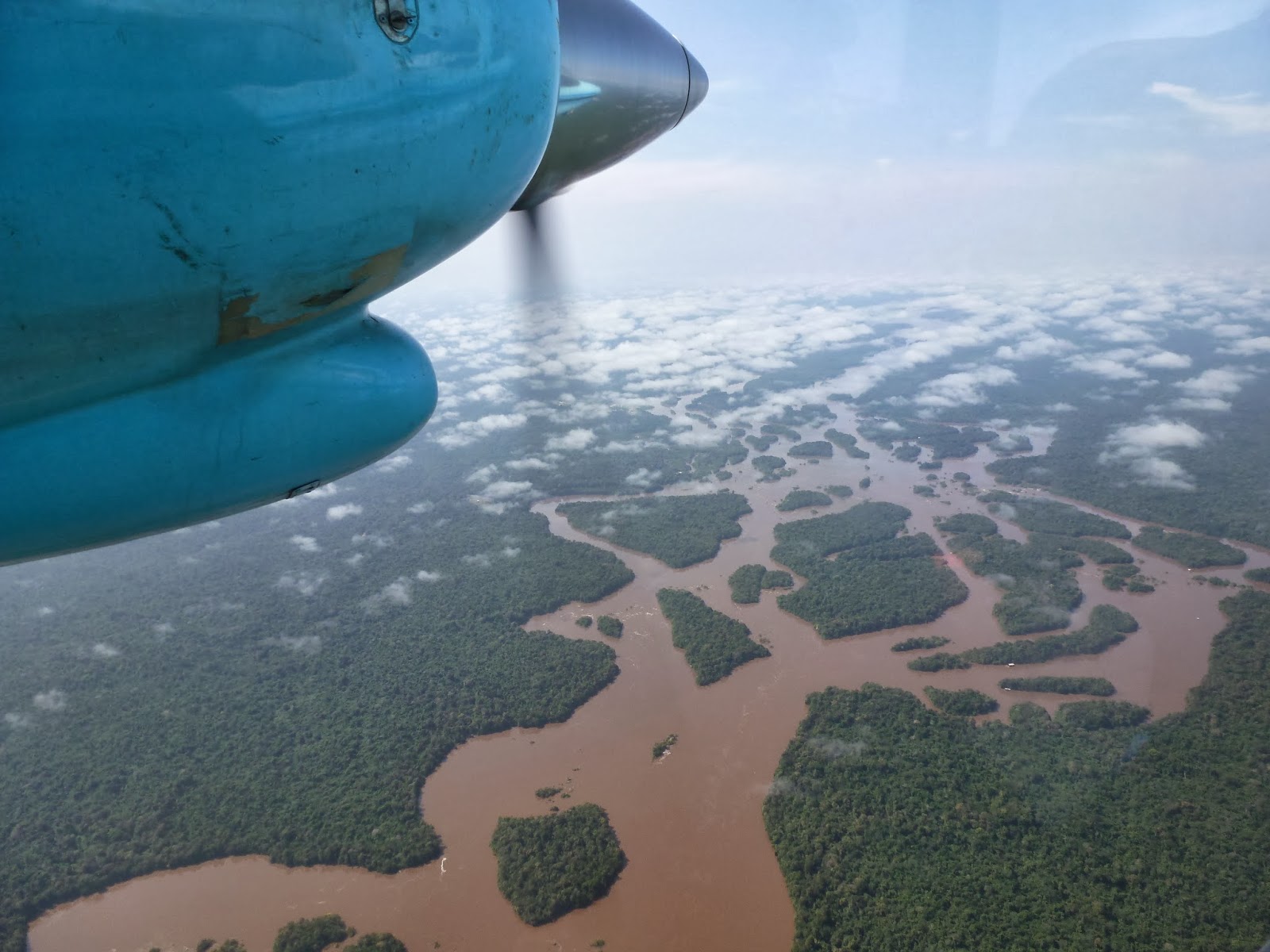
The plane was even smaller than expected. 4 seater with all our stuff squashed in behind. Very noisy but worth it for the views of Georgetown's suburbs disappearing, giving way to endless green, the mighty brown Essequibo. Mahdia (central town of region 8) sat at the foot of the hills, the point where the flat lands rise all of a sudden to form a barrier, a step up to an unknown land.
In Mahdia we waited. And waited. We played cards, chatted to some Chenapou villagers, but mostly we just waited. It was fascinating watching the planes come, unload, load, take off again all in the blink of an eye.
By 4pm roughly, our bags were next in line. Our plane had no seats in the back, we had to cimply perch on a ledge, a couple of kids in front of us sitting on boxes.
I was exhausted, but completely amazed by the beauty we were flying over. Hills and valleys in sunshine, cloud, rain, every shade of green. I felt like the luckiest person alive to have been given this glimpse of one of natures wonders.
A crowd of villagers stood at the airstrip, many welcomed us, shook hands. Children started picking up our boxes. All around the rainforest looked spectacular in the evening light. I felt overwhelmed. This was my home now, I had made it at last, after months of anticipation, weeks of waiting, days of travelling. Chenapou.
The night is now a blur. I'm writing this after two days. The two most bizzare, tiring, mind boggling, stressful, fascinating, difficult, crazy days of my life. Everything is different.
All I remember is noises in the night, the terror of what sounded like rats. Turned out to be a moth. A bird sized moth though. Hammocks, nets, dust, candles, roti, sleep. Cold. What, cold!? Sleeping bag. Sleep again.
I got barely any sleep the night before we flew to Chenapou. Seemed to spend half the night chasing a cockroach around the inside of my mozzie net. Then got up early, final bit of packing, tidying up the flat, no sign of a vehicle from MOE (Minisitry of Education) so Rishon takes us to Ogle Airport.
 After a few phone calls we manage to get some baggage paid for, but still need to cough up 25 grand for overweight. Then there's the fun of getting through Immigration. Our 2 week stay on the tourist visa has expired, and we have no official permission to be in the country. Thankfully our letters of appointment from MOE save us.
The plane was even smaller than expected. 4 seater with all our stuff squashed in behind. Very noisy but worth it for the views of Georgetown's suburbs disappearing, giving way to endless green, the mighty brown Essequibo. Mahdia (central town of region 8) sat at the foot of the hills, the point where the flat lands rise all of a sudden to form a barrier, a step up to an unknown land.
 |
| "When oh when will our plane come?" |
By 4pm roughly, our bags were next in line. Our plane had no seats in the back, we had to cimply perch on a ledge, a couple of kids in front of us sitting on boxes.
A crowd of villagers stood at the airstrip, many welcomed us, shook hands. Children started picking up our boxes. All around the rainforest looked spectacular in the evening light. I felt overwhelmed. This was my home now, I had made it at last, after months of anticipation, weeks of waiting, days of travelling. Chenapou.
The night is now a blur. I'm writing this after two days. The two most bizzare, tiring, mind boggling, stressful, fascinating, difficult, crazy days of my life. Everything is different.
All I remember is noises in the night, the terror of what sounded like rats. Turned out to be a moth. A bird sized moth though. Hammocks, nets, dust, candles, roti, sleep. Cold. What, cold!? Sleeping bag. Sleep again.
Friday, 20 December 2013
First Term Project Report
Dear Sponsors,
I am writing from Guyana to update you on the progress made at my teaching project in Chenapou Primary School.
The first school term began on the 2nd of September, and from this date I was given responsibility for teaching grade 2- a class of 22 students aged six and seven years old. To begin with, controlling the behavior of such a large number of young children seemed like an impossible task, especially in a tiny classroom with not enough benches, desks or books.
Over the first few weeks of teaching I began to discover methods of classroom management, including a gold star reward system, strict class rules and detaining pupils who came in late from recess or lunch. The challenge then really became how to teach the children as effectively as possible.
I focused first on turning our dull classroom into a more colourful, interesting learning environment by making posters and charts for the walls, and putting up pictures drawn by the pupils. As the school has no janitorial staff, it was also up to me to clean out the classroom every morning and arrange it properly, moving out a rotten cupboard and knocking out boards from the windows to allow some light in.
It did not take long for me to realise that me talking to the pupils or asking them to copy from the blackboard, was not going to teach them anything. I had to start making my lessons as interactive as possible, with many actions and objects to hold. Simple things such as using old cardboard to make number cards, letters cards and word cards opened up a whole new range or possibilities. For science lessons I started taking the class outside more often- to follow a compass North or to count how many types of fruit tree they could spot. Games such as hangman, wordsearches and tongue twisters were useful warm ups for English, and the children loved having team mental maths competitions at the start of every maths lesson.
Then came the real breakthrough- I picked up the school guitar and began to sing. If you stand and talk to grade 2, nobody will be listening, but if you start singing, it will be a different matter. As a class we began the day and end the day every day with a few songs- some nursery rhymes and a song that I invented to help them remember the date, as well as Christmas carols later on in the term. This instantly improved the attitude and mood of the pupils, and taught them a lot at the same time. When it came to the end of term Christmas concert, grade 2 were by far the most confident performers.
One other routine that made a huge difference was 'Golden Time'- just twenty minutes or so at the end of a Friday afternoon for the children to look at books, draw pictures, use my calculator or make models. This treat was enough of an incentive to improve the behavior of the pupils throughout the week.
Unfortunately it was just as we had settled into a solid routine and a comfortable classroom, when disaster struck. Contractors arrived with no warning one morning and started removing the shingle roof from our classroom, in order to replace it with zinc (a job which was still incomplete when I left Chenapou). This meant that we were forced to use a football stand as a makeshift classroom for the last few weeks of term, including the end of term tests. The results of my tests showed a lot- for English, which required the pupils to read and write, there was a clear cut division between the ones who could read (and got As) and those who couldn't read (and failed or got 0%). In subjects where I did aural assessments individually with the pupils, they scored much more consistently across the class. I had been trying to combat this poor reading ability by creating reading groups and holding reading sessions during lunchtimes, but much more work is clearly needed on this next term.
My plan to improve the performance of grade 2 next term is to spend some time every day learning basic phonetics, so as to help those who cannot read at all to catch up. I would also like to start incorporating more experiments and models into science and social studies lessons to make them more interesting for the pupils. Getting the pupils to answer all questions in full sentences and standard English (as opposed to their Creole) will make a big difference to their speaking and writing skills.
Without making this letter too much longer than it already is, I would like to mention some of my activities in Chenapou outside of my work at the school. I have found it fascinating gradually learning about Amerindian life and trying it for myself; working on farms, planting cassava, making cassava bread and cassiri, going fishing on the river, going hunting out in the bush. My partner Ben and I love the Potaro river so much that we asked a man to dig out an Amerindian canoe for us. We helped drag the boat down the mountain from the tree it was cut from, and watched him complete it by roasting it in a fire.
I have experienced hot sun and tropical rainstorms and watched the river rise and fall. I have met too many snakes for my liking, as well as all kinds of beautiful trees, insects and birds. I have learnt how to handwash clothes, how to clean a house, how to cook for myself and how to sleep in a hammock. I have learnt too many things to write here, but perhaps the most important one is how to share. The Amerindian way of life is to share everything. Wherever you go, cassiri and cassava bread are free, camping is free, and you are welcomed as family. They share their work too- helping each other on their farms in community events called cayap. It seems to me that it is this sharing attitude that defines their culture.
Thank you for taking the time to read this letter and thank you for supporting this project. I hope I have convinced you that I have been, and will continue to make the most of my time in Guyana and do the best I can for my pupils. I hope also that you are well, and would like to wish you a happy Christmas and new year.
I am writing from Guyana to update you on the progress made at my teaching project in Chenapou Primary School.
The first school term began on the 2nd of September, and from this date I was given responsibility for teaching grade 2- a class of 22 students aged six and seven years old. To begin with, controlling the behavior of such a large number of young children seemed like an impossible task, especially in a tiny classroom with not enough benches, desks or books.
Over the first few weeks of teaching I began to discover methods of classroom management, including a gold star reward system, strict class rules and detaining pupils who came in late from recess or lunch. The challenge then really became how to teach the children as effectively as possible.
I focused first on turning our dull classroom into a more colourful, interesting learning environment by making posters and charts for the walls, and putting up pictures drawn by the pupils. As the school has no janitorial staff, it was also up to me to clean out the classroom every morning and arrange it properly, moving out a rotten cupboard and knocking out boards from the windows to allow some light in.
It did not take long for me to realise that me talking to the pupils or asking them to copy from the blackboard, was not going to teach them anything. I had to start making my lessons as interactive as possible, with many actions and objects to hold. Simple things such as using old cardboard to make number cards, letters cards and word cards opened up a whole new range or possibilities. For science lessons I started taking the class outside more often- to follow a compass North or to count how many types of fruit tree they could spot. Games such as hangman, wordsearches and tongue twisters were useful warm ups for English, and the children loved having team mental maths competitions at the start of every maths lesson.
Then came the real breakthrough- I picked up the school guitar and began to sing. If you stand and talk to grade 2, nobody will be listening, but if you start singing, it will be a different matter. As a class we began the day and end the day every day with a few songs- some nursery rhymes and a song that I invented to help them remember the date, as well as Christmas carols later on in the term. This instantly improved the attitude and mood of the pupils, and taught them a lot at the same time. When it came to the end of term Christmas concert, grade 2 were by far the most confident performers.
One other routine that made a huge difference was 'Golden Time'- just twenty minutes or so at the end of a Friday afternoon for the children to look at books, draw pictures, use my calculator or make models. This treat was enough of an incentive to improve the behavior of the pupils throughout the week.
Unfortunately it was just as we had settled into a solid routine and a comfortable classroom, when disaster struck. Contractors arrived with no warning one morning and started removing the shingle roof from our classroom, in order to replace it with zinc (a job which was still incomplete when I left Chenapou). This meant that we were forced to use a football stand as a makeshift classroom for the last few weeks of term, including the end of term tests. The results of my tests showed a lot- for English, which required the pupils to read and write, there was a clear cut division between the ones who could read (and got As) and those who couldn't read (and failed or got 0%). In subjects where I did aural assessments individually with the pupils, they scored much more consistently across the class. I had been trying to combat this poor reading ability by creating reading groups and holding reading sessions during lunchtimes, but much more work is clearly needed on this next term.
My plan to improve the performance of grade 2 next term is to spend some time every day learning basic phonetics, so as to help those who cannot read at all to catch up. I would also like to start incorporating more experiments and models into science and social studies lessons to make them more interesting for the pupils. Getting the pupils to answer all questions in full sentences and standard English (as opposed to their Creole) will make a big difference to their speaking and writing skills.
Without making this letter too much longer than it already is, I would like to mention some of my activities in Chenapou outside of my work at the school. I have found it fascinating gradually learning about Amerindian life and trying it for myself; working on farms, planting cassava, making cassava bread and cassiri, going fishing on the river, going hunting out in the bush. My partner Ben and I love the Potaro river so much that we asked a man to dig out an Amerindian canoe for us. We helped drag the boat down the mountain from the tree it was cut from, and watched him complete it by roasting it in a fire.
I have experienced hot sun and tropical rainstorms and watched the river rise and fall. I have met too many snakes for my liking, as well as all kinds of beautiful trees, insects and birds. I have learnt how to handwash clothes, how to clean a house, how to cook for myself and how to sleep in a hammock. I have learnt too many things to write here, but perhaps the most important one is how to share. The Amerindian way of life is to share everything. Wherever you go, cassiri and cassava bread are free, camping is free, and you are welcomed as family. They share their work too- helping each other on their farms in community events called cayap. It seems to me that it is this sharing attitude that defines their culture.
Thank you for taking the time to read this letter and thank you for supporting this project. I hope I have convinced you that I have been, and will continue to make the most of my time in Guyana and do the best I can for my pupils. I hope also that you are well, and would like to wish you a happy Christmas and new year.
Thursday, 19 December 2013
Blogging without an Internet Connection
Hello internet, it's been a while.
After 15 weeks in the rainforest, the bush, the jungle, the interior, the hinterlands, the middle of nowhere, or simply 'home' as I now like to call it- I have arrived back in Georgetown for the Christmas holidays. It took three days of waiting for a plane, then a grueling 11 hour ride in a packed minibus along potholed roads, but Ben and I made it back eventually. Back on the map, back to things like roads and cars and people, back to phone calls and emails and electricity and bright lights and all sorts of strange and fancy things like that.
Let me explain how blogging from a place with no internet is going to work.
I have already done lots of blogging, you just don't realise it yet. Over the term I have been collecting photos and stories and observations and diary entries of interest, ready to be typed up. But of course I can't post it all at once because then nobody will read it all.
Thanks to some magical Google buttons, I can delay when the posts appear to be published, and pretend that I'm uploading them once a week from Chenapou. You can pretend too that you are receiving them real-time, or jut accept that you're getting the story in the right order, just 3 months behind when it actually happened.
Just treat it like people treat the newspapers the receive in Chenapou- getting the news 15 weeks late is better than no news at all.
So, after I have published a little project report of the first term (plot spoiler), we can start imagining that I have just arrived in Chenapou, and see where it goes from there. You can expect one post every Saturday.
After 15 weeks in the rainforest, the bush, the jungle, the interior, the hinterlands, the middle of nowhere, or simply 'home' as I now like to call it- I have arrived back in Georgetown for the Christmas holidays. It took three days of waiting for a plane, then a grueling 11 hour ride in a packed minibus along potholed roads, but Ben and I made it back eventually. Back on the map, back to things like roads and cars and people, back to phone calls and emails and electricity and bright lights and all sorts of strange and fancy things like that.
Let me explain how blogging from a place with no internet is going to work.
I have already done lots of blogging, you just don't realise it yet. Over the term I have been collecting photos and stories and observations and diary entries of interest, ready to be typed up. But of course I can't post it all at once because then nobody will read it all.
Thanks to some magical Google buttons, I can delay when the posts appear to be published, and pretend that I'm uploading them once a week from Chenapou. You can pretend too that you are receiving them real-time, or jut accept that you're getting the story in the right order, just 3 months behind when it actually happened.
Just treat it like people treat the newspapers the receive in Chenapou- getting the news 15 weeks late is better than no news at all.
So, after I have published a little project report of the first term (plot spoiler), we can start imagining that I have just arrived in Chenapou, and see where it goes from there. You can expect one post every Saturday.
 |
| Heading out on the 1st September. Essequibo River. |
Saturday, 31 August 2013
Goodbye Georgetown
Sidestepping a puddle that covers half the street, you are suddenly reminded that earlier in the day it was raining so hard, that you were soaked to the skin just crossing the road to get into a taxi. You wouldn't know otherwise, from the clear blue sky, the burning sun overhead. Sidestepping the puddle is easier said than done- the lack of any pavement pushes you into the path of minibuses that fly around the road, overtaking the rusted trucks, the horse drawn carts, the mopeds and the cyclists balancing huge tanks of water on their bike frames.
Looking up past the iconic clock tower of Starbroek market, you notice the funnel of a ship, which reminds you that you are just metres away from the Atlantic Ocean. Another thing it is easy to forget. Georgetown does not thin out towards the sea, it doesn't even register its existence until it abruptly meets the narrow stone wall that separates road from water, and just stops there. You could wander around the town for hours and not catch the slightest glimpse of the coast.
Ben and I walked back to the flat yesterday: past Giftland for soap; past the hardware store to pick up long boots; through the bustling, noisy market; coming out by the famous cathedral (highest wooden building in the world); then on to the post office and Umana Yana, the huge Amerindian hut; and finally to the sea wall which we walked almost the entire length of on our way to Cambellville, our district of Georgetown. The sun beat down on us the whole way, and we felt we deserved a cold coke from OMG (the cafe next to the flat) and a lie down in a hammock after that.
We had been working at "School of the Nations", across the other side of town, helping to set up the library by filling up the shelves with box-fulls of books that had been donated from Canada. We were slightly jealous of the fact that they had more books than they could ever fit in their library, whilst we will be lucky to have just a handful of books in Chenapou, where we hope to be tomorrow.
Georgetown has been a fascinating experience, but as much as I have loved the places and people I've met here, I can't wait to get on that little plane tomorrow and fly over the rainforest, end up somewhere more remote than I've ever been before. I can guarantee there will not be an internet cafe like this one in Chenapou, so this is probably the last blog post for a while! I'll leave you with a couple of pictures. Remember you can see more photos if you click on the photo gallery link at the side of this page.
 |
| Breadfruit; fried on the left, boiled in the middle + sauces on the right |
 |
| Umana Yana |
 |
| The Seawall |
Wednesday, 28 August 2013
First Glimpse of the Rainforest
Beyond the murky waters of the creek the trees begin to rise. The forest wall is thick with impenetrable vegetation, every leaf and shoot clawing for the precious sunlight, plants scrambling over each other, digging into each other with long, sharp thorns. The effect is a barrier, hiding the rainforest within, a forest that is one of the most pristine of its kind in the world. It stretches for hundreds of miles from where I stand. Behind that barrier, somewhere in that world of ants and vines, is my new home.
The forest allows just a few exciting glimpses- including a long trail of leaf cutter ants, scurrying with their loads up a tree in one direction and out of sight into the undergrowth in the other direction.
This creek is where we spent last Sunday, taking some time to swim and relax together before we all packed up and headed out to our projects.
Apart from us. Ben and I waved off the last two volunteers this morning, who set off across the wide waters of the Essequibo in a small boat, their cardboard box wobbling precariously at the front. Then back to the flat it was for us, to be greeted with the task of clearing up and cleaning the mess of 24 people. We found the largest frog I have ever seen in one of the bedrooms.
The last two days have brought rain. And nothing like the Scottish drizzle I'm used to. Proper rain in which you find yourself soaked to the skin after a few seconds, that pours of the roof in waterfalls and turns the driveway into a small lake. And puts a stop to the game of cricket we were playing.
The forest allows just a few exciting glimpses- including a long trail of leaf cutter ants, scurrying with their loads up a tree in one direction and out of sight into the undergrowth in the other direction.
This creek is where we spent last Sunday, taking some time to swim and relax together before we all packed up and headed out to our projects.
Apart from us. Ben and I waved off the last two volunteers this morning, who set off across the wide waters of the Essequibo in a small boat, their cardboard box wobbling precariously at the front. Then back to the flat it was for us, to be greeted with the task of clearing up and cleaning the mess of 24 people. We found the largest frog I have ever seen in one of the bedrooms.
The last two days have brought rain. And nothing like the Scottish drizzle I'm used to. Proper rain in which you find yourself soaked to the skin after a few seconds, that pours of the roof in waterfalls and turns the driveway into a small lake. And puts a stop to the game of cricket we were playing.
 |
| Before the Rain |
 |
| After the Rain |
Friday, 23 August 2013
Georgetown
It was a strange feeling, watching the houses of Edinburgh shrink beneath me, disappear behind the clouds, knowing that it was the last time I'd see Scotland for a year. Three flights later, many hours later, many plastic cups and trays of plane food later, it was dark, save for the occasional flashes of a distant thunderstorm, and a few pinpricks of light. These pinpricks of light were the only trace of a whole country beneath me. Guyana, almost invisible by night.
Stepping off the plane felt like stepping into a bath. The
warmth and humidity, even in the middle of the night, caught us all by
surprise. We bundled into stuffy minibuses, winding open the windows and
relishing in the breeze as we zoomed through the streets towards Georgetown. New,
indescribable smells wafted in that breeze, whilst our eyes were glued to the
houses flashing past. Amazing houses, all wooden, on stilts, and every one
unique in design, decorated with elaborate patterns and colours.
I’ve been in the flat with thirteen other Project Trust
volunteers since Sunday night, battling the cockroaches, the holes in the mosquito
nets, the relentless heat and the heavy tropical rain. It’s not really so hard,
we are cooked for by Rishon every day, fresh pineapples for breakfast and
home-made rotis with dahl for dinner.
Our time here, when we are not shopping for our projects or
attending training at the Ministry of Education, has been spent visiting the
zoo, meeting the British High Commissioner and relaxing around the flat.
Most volunteers are heading off to the interior on Wednesday
of next week, however the limited flights to Chenapou mean that Ben and I
cannot leave Georgetown until a week on Sunday. This is slightly scary as the school
term is supposed to begin the day after! Even so I’m looking forward greatly to
getting out there, leaving the noises of the city for the peace and remoteness
of the rainforest.
Subscribe to:
Posts (Atom)